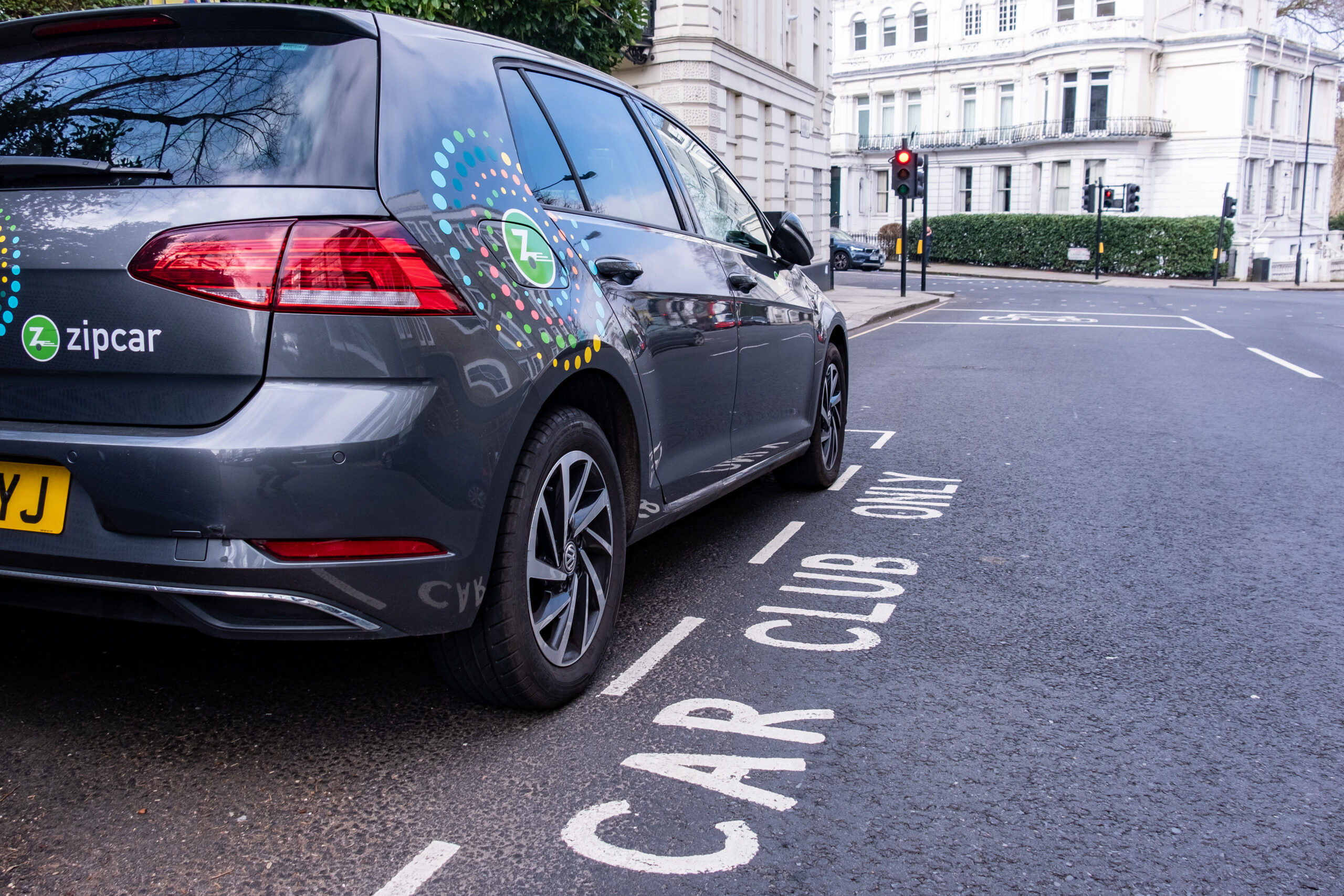
Zipcar’s demise and the opportunities for car clubs, car-sharing and car-pooling.
Zipcar, a subsidiary of Avis Budget, was the largest car sharing operator in London and the UK with an estimated 650,000 members in the UK, of which more than 550,000 of these were in London.
Zipcar ceased operations in the UK at the end of December 2025 citing contributing factors as rising operational and energy costs, incoming changes to the congestion charge to cover electric vehicles and the cost of parking (Transport Committee, Greater London Authority, December 2025). Other barriers included that Zipcar’s floating cars, which have no fixed parking space, were not allowed to park within some central areas including Camden and the City of London. Zipcar had already exited Oxford, Cambridge and Bristol during 2024 to concentrate solely on London.
What are car clubs and why do we need them?
Car clubs are short-term car rental services that allow members to access locally parked cars and pay by the minute, hour or day.
Car clubs offer an alternative to private car ownership for individuals and businesses. They reduce the need for private parking and can help people give up their cars while allowing for occasional car travel.
There are different types of car clubs, ranging from ‘back-to-base’ returnable models to flexible one-way models, with dedicated parking bays and areas.
What are the benefits of car clubs?
TfL states that Car Clubs have the following benefits:
Sustainable travel behaviours. Car clubs have the potential to reduce car ownership, inspiring a shift away from private car use to walking, cycling and public transport.
Benefits for businesses. Car clubs can help businesses and charities access the cleanest vans and cars, save money and reduce emissions.
Aiding the transition to electric vehicles. Many car clubs now operate electric or hybrid vehicles capable of operating with zero emissions.
Environmental and safety benefits. By encouraging people to transition to cleaner vehicles with the highest safety rating, car clubs can improve air quality and reduce the risk of collisions.
The central aim of the London Mayor’s Transport Strategy (MTS) is that by 2041 80% of trips in London are made by sustainable modes including walking, cycling and public transport. The MTS sees a role for car clubs in parts of inner and outer London when paired with a reduction in car ownership and use (Taking TfL’s car club policy forward, July 2022).
Why join a car club?
The RAC Foundation’s research states that the average car or van in England is driven less than 5% of the time; most of the time, it is either parked at home (73%) or parked elsewhere (23%) (Which article, “Car Clubs Explained, April 2025).
Meanwhile, the cost of car ownership is high due to the cost of fuel, insurance, taxes, servicing and repairs, as well as annual depreciation in the car’s value.
In comparison, car club membership allows drivers to drive modern, reliable vehicles without the high price and responsibilities of ownership.
Research from CoMoUK, the national organisation for shared transport, found that, on average, using an EV through a car club can save you £5,573 a year compared to owning a new EV (CoMoUK, October 2023).
How sustainable are car clubs?
CoMoUK estimates that in 2023 each car club vehicle in the UK replaced between 14 and 32 private cars (TfL’s Stalling Car Clubs, London Assembly Transport Committee, April 2025).
On average, car club vehicles produce fewer emissions. According to CoMoUK, 35% of car club cars are fully electric, compared with less than 2% of private cars. A further 35% of car club cars are hybrid or plug-in hybrid, and all car club cars are compliant with Low Emission Zones.
Car club operators looking to expand
The exit of Zipcar opened up the London car club market, assuming the operation is commercially viable for other operators. London is seen as one of the most promising cities in Europe for car sharing because it has a large population where the majority rely on travelling by public transport rather than owning their own cars.
According to the Guardian (December 2025), several car-sharing companies are considering launching or expanding in London, including Free2move, Enterprise Car Club and Co Wheels.
Free2move, owned by the carmaker Stellantis (manufacturing Peugeot, Vauxhall and Fiat), currently operates in several European cities and Washington DC. It is monitoring the London market and considering service options.
Enterprise Car Club already has 1300 cars and vans in the UK with most being in London and operates in 30 London boroughs. Enterprise is seeking opportunities to expand its network, including hourly or daily rentals.
Co Wheels, a smaller business, operates across the UK with over six hundred vehicles and a few cars in London. Co Wheels made a statement at the time of Zipcar’s announcement that “rising costs from parking permits and on-street bay fees to electricity, insurance and congestion charges place significant pressure on operators” and that “these costs have prevented companies like Co Wheels from expanding into London, hindering any opportunity for a multi-operator approach” (Co Wheels Response to Zipcar UK Announcement, December 2025). However, the company has said it was “actively discussing” options with several London boroughs more recently.
In response to the criticism of the introduction of the congestion charge for electric vehicles, TfL has partially addressed the issue as from 2 January 2026, it introduced a new 100% discount for electric car club vehicles that are picked up and returned to the same bay within the Congestion Charge zone. This would not assist floating vehicles.
Peer-to-peer car-sharing and car-pooling
In terms of different types of car clubs, the peer-to-peer car-sharing companies Hiyacar and Turo also said they hoped to expand the number of car owners using their platforms in London, with the exit of Zipcar. Car-pooling may also become more popular.
How does peer-to-peer car-sharing work?
Peer-to-peer car-sharing organisations such as Hiyacar enable people to hire cars from people in their local area via an app. There is no membership fee or deposit, owners are paid a set time rate plus a booking fee, and the person hiring the car is required to cover fuel or charging.
Insurance is included per trip, but the excess is high unless you pay to reduce it. It can be cost-effective for short local trips but availability and quality vary by area and owner.
Hiyacar density is highest in London but it also operates in other large cities such as Manchester (Source: Hiyacar – Car Clubs).
The verification process for drivers includes identity, licence validity and minimum age (21) (Source: Hiyacar website).
Owners are required to ensure cars are roadworthy, clean with a full tank of petrol and that their car’s availability is accurate.
Car-sharing models such as Hiyacar and Turo could potentially take advantage of the minimal use of most cars mentioned above; that the average car or van in England is driven less than 5% of the time. If car sharing were used on a wider scale particularly in cities, they could reduce car ownership and free up kerbside space (and / or off-street parking space) that could be used for other purposes such as disabled parking, delivery and servicing or reallocation to pedestrians, cyclists or buses.
What is car-pooling?
In addition to peer-to-peer car sharing, there are carpooling organisations such as BlaBlaCar. BlaBlaCar allows drivers to publish their trips, passengers book seats and then share fuel and toll costs. It operates in Europe (including in London, Manchester, Leeds, Birmingham, Bristol, Reading and Sheffield) and South America and is popular for trips between areas and cities that are not well-connected by direct trains.
The organisation addresses concerns that users may have about personal security including advising users to use ratings and verified ID, communicate only through BlaBlaCar, confirm the meeting point, and as a woman, look out for women only rides. It also recommends charging your phone before you travel, sharing your trip details and ensuring fellow car-poolers and the vehicle match the descriptions. It gives basic road safety advice to passengers such as using seatbelts, putting luggage in the boot, checking if child seats are required and not distracting the driver. Drivers are reminded not to use their phones, to take breaks every two hours, ensure they are well-rested before travelling at night, ensure the car is insured and has a valid MOT, check tyre pressure, oil, water, brakes, headlights, windscreen wipers and respect traffic laws (BlaBlaCar website, 2026).
Responding to the profile of current car club users
Are peer-to-peer car-sharing and car-pooling likely to be viable alternatives to car clubs for the current users?
Research for TfL that was conducted in 2024 found that only a small group of Londoners uses car clubs – mostly younger, relatively affluent men with children. They are used for a mixture of leisure and non-leisure trips including visiting friends and family, moving bulky items and errands (Source: Car Clubs Customer Research, 2CV for TfL, August 2024).
Car club users do use public transport less than all Londoners although they do still use it frequently and 8 in 10 car-free car club users say they intend to buy a vehicle in the next 2 years: significantly more than all Londoners. This may suggest that their car-free status whilst they use car clubs may be only a temporary effect.
Car-sharing suits city-based drivers for occasional, short-notice access to a specific type of car near home without subscriptions, and who are willing and able to compare owner listings for price, mileage caps and other conditions.
Car-pooling such as BlaBlaCar is generally used for longer distance trips such as London to/from Manchester, Birmingham, Reading and Bristol (Source: BlaBlaCar website).
According to the research carried out for London, car-sharing may suit existing car club users for some trips such as moving bulky items and errands. Car-pooling may also work for intercity trips or where and when connections are poor such as holiday periods.
What next?
If the provision of car clubs is still a policy objective of TfL’s and the London boroughs, in order for existing car clubs to expand in London or for new car clubs to set up, it is likely that concessions will need to be made, including reducing fees. Some boroughs are already looking at reducing or waiving permit fees while others are waiting until the new financial year. Consistency across boroughs would simplify the situation for operators.
Expansion by peer-to-peer companies such as Hiyacar and Turo would be less expensive than for traditional car club operators, as they are not reliant on a fleet of cars, only on linking existing owners to potential renters.
With the demise of Zipcar there are clear opportunities for the expansion of traditional car club models but also for car-sharing and car-pooling. It will be interesting to see how the market develops and how users respond.