Building it makes some come, but how do we make them all come?
“If we focus on what we want nudges to do when encouraging more people to use active travel they should work at the moment of decision to disrupt existing automatic patterns.”
We need to think beyond infrastructure to drive an uptake in active travel.
Active travel modes are my preferred way of getting around. I myself am a city-hopping cyclist and I rely on my bike to get me from A to B to C to D and all the way to Z. I can give myself a pat on the back for ‘doing my part’ when it comes to my carbon reductions, and I can comfortably finish a big bag of crisps at the end of the day because all my zooming around means ‘I deserved it,’ but I have become oblivious to factors that may be preventing people from getting on bikes and doing as I do.
This shift to active travel is fundamental when thinking about the ambitious carbon reduction targets and cycling mode share targets that are outlined in the London Plan (2021). Infrastructure improvements have proven to be a successful tool to support the culture shift from using non-active modes of travel to relying on active travel as the main form of getting around. An early example of this is the initial implementation of Cycle Superhighways in London in 2010, which led to the implementation of Cycle Superhighways in the City in 2016. This initiative has helped contribute to a notable 70% increase in cycling trips from 2017 to 2024 in the City.
A more recent example is the reopening of Hammersmith Bridge to cyclists and pedestrians in April 2025. Lime, the dockless e-bike company, has published data that demonstrates the reopening of the bridge solely to pedestrians and cyclists has resulted in a dramatic increase in e-bike usage across Hammersmith and Fulham, with Lime saying that trips have more than doubled. As a result, Lime has expanded its infrastructure in the borough by tripling the number of designated parking bays and increased the number of on-street staff to mitigate anti-social parking. These two examples of infrastructure implementation demonstrate the pivotal role that infrastructure improvements play in encouraging an active travel uptake. However, the question remains of how we get everyone to join us.
Think and blink…
Behaviour change tools, particularly nudges, are a powerful means of introducing small design tweaks that can shift behaviour in communities, without restricting choice or requiring major incentives. There are two types of decisions that we can make: ‘think’ and ‘blink’.
Nudges focus on designing into our ‘blink’ decisions. These are fast, intuitive and automatic decisions we make without thinking – a snap decision. They are driven by habit, emotion, mental shortcuts and environmental cues. For instance, this may be when you brush your teeth, what you eat for breakfast, or how you get to work.
If we focus on what we want nudges to do when encouraging more people to use active travel they should work at the moment of decision to disrupt existing automatic patterns.
We want cycling or walking to be the easy, logical choice. Not because we say it is, but because small design interventions make it the default. Examples of nudges can be specific to households, wider communities or workplaces. Categories of these could include default options, social proof and accessibility.
When thinking about design by default, maps are a good place to start. Considering I spend most of my time with my phone by my side, I would have thought it would know me by now – but alas it seems I am still misunderstood! Despite my selecting the cycling option every time I open Google Maps or City Mapper, I am still required to reselect cycling every time I want to get directions. While this is a grievance of mine it means that people who are on the fence about whether they should cycle or not are led away from the option and may not even give it a second thought. Implementing the option to have cycling or walking as your default mode on map apps would nudge people towards making more trips by active modes, instead of relying on private vehicles or public transport.
Nudging towards active travel.
Social proof nudges have already proven to be successful with the implementation of display boards showing real-time cycling numbers on bike counters. This was demonstrated to me personally when I started cycling for my commutes in Wellington, New Zealand, where I’m originally from. My commute would take me along Oriental Parade and past a display board that showed me the number of daily trips and the total number of trips per month made by bike since its implementation in 2019. This board became a part of my routine. I quickly became hooked on watching the numbers increase and seeing numbers change from day to day. It also demonstrated to me with other people cycling to commute that this was a collective effort to move towards active travel that had tangible benefits as more of these counters were implemented across the city.
While we can get caught up in how we get people on the bike in the first place and ensure that their journey is smooth, we often forget about the final step in the journey: where do you park your bike?
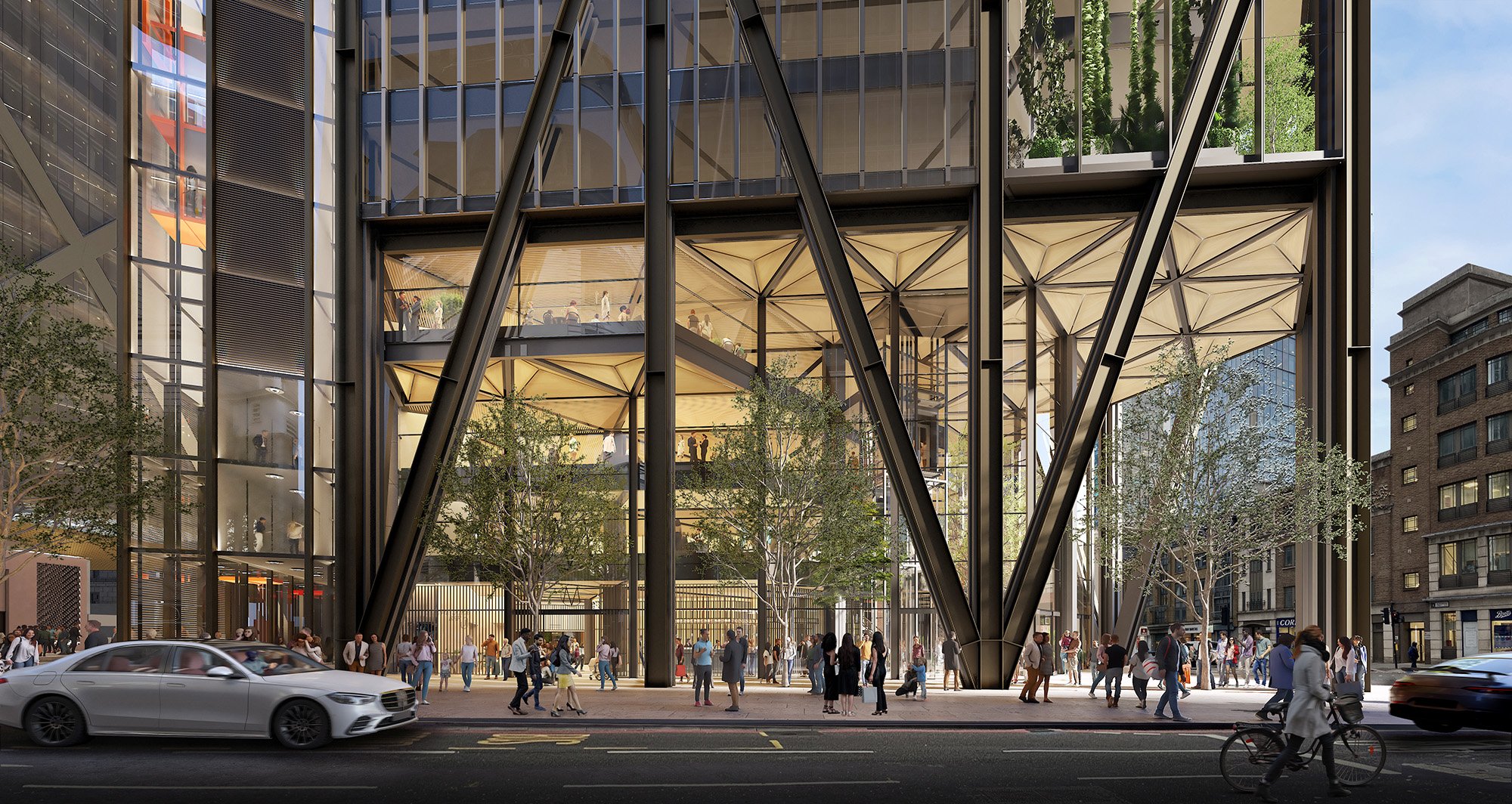
In recent years London has been leading the way with the introduction of accessible, state-of-the-art cycle parking facilities in commercial developments. Momentum’s involvement in the successful planning application for 99 Bishopsgate saw the design of a bespoke, high-capacity, cycle parking hub with spaces located both at ground and basement level. In addition to the proposed 1,600 long-stay and 144 short-stay cycle parking spaces that will be provided, the end-of-trip facilities, including lockers, showers and changing facilities, are in line with the cycle parking provision required and anticipated demand. Providing a dedicated, secure and accessible facility for cyclists removes the ‘think’ decision of where to park and replaces it with a ‘blink’ decision that becomes engrained in the routines of employees using the facility.
The significant rise in the number of active travel trips made when compared to non-actives modes is impressive and is thanks, for the most part, to the infrastructure schemes that have been implemented around London that facilitate clear cycle routes to the places we need to go.
The next step for London is to take our good level of active travel trips to a great level. The use of default, social proof and accessibility focused nudges will encourage ‘think’ decisions to become ‘blink’ decisions.
Sources: