New towns in the UK: A question of delivery.
“Towns are not collections of houses. They are collections of neighbourhoods. Creating that social and physical fabric is the hardest part, and recent history offers several lessons that we can learn from.”
The UK government’s renewed interest in new towns has been positioned by ministers as central to addressing the housing crisis. Yet, as Building magazine’s Joey Gardiner recently highlighted, progress at Tempsford has been disappointingly slow despite its strategic location and designation as one of the most “promising” potential new towns in the country.
Tempsford, a village of around 600 people, was identified by the New Towns Taskforce as a site capable of delivering 40,000 homes and serving as a model for the next generation of planned settlements. Its potential for connectivity appears at odds with the government’s lack of formal commitment to the scheme.
This dynamic raises a stark question: if a site as well-located as Tempsford cannot be mobilised quickly, what hope is there that the wider New Towns programme can deliver at the scale and pace the housing crisis demands?
Why new towns are hard to deliver.
One of the risks in the current debate is underestimating just how difficult new towns are to create, if we want them to be more than simply housing estates clustered around a new station.
Successful towns require far more: a sense of place, walkable neighbourhoods, local high streets, schools, healthcare, markets and everyday spaces where people naturally encounter one another. In short, towns are not collections of houses. They are collections of neighbourhoods. Creating that social and physical fabric is the hardest part, and recent history offers several lessons that we can learn from.
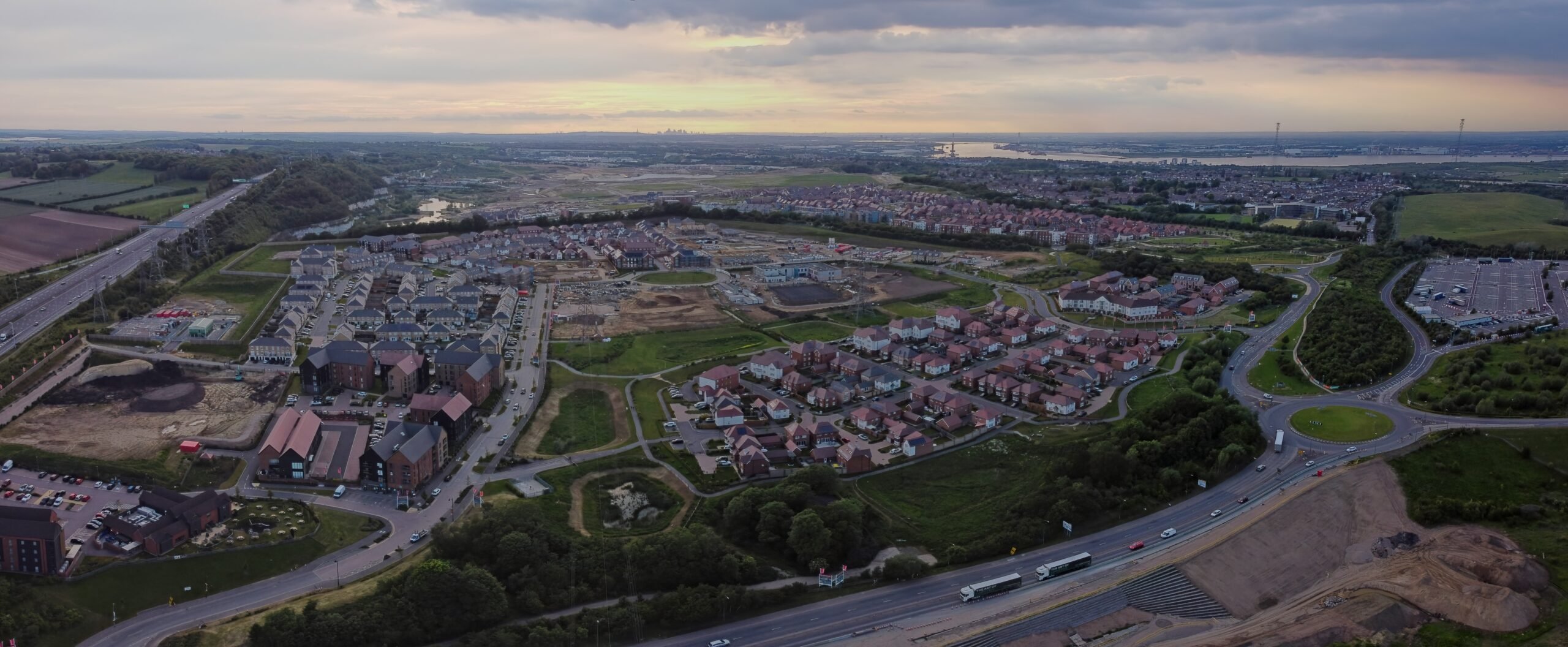
Ebbsfleet in Kent, often cited as a modern example, demonstrates the challenge. Despite being located on HS1, only a fraction of its planned housing has been delivered decades after it was launched (although the Development Corporation set up in 2015 is speeding up development). High commuting costs, a station located far from the town centre, and the fact that many residents moved in before a functioning local centre existed have all undermined its success. The result has been a car-dependent lifestyle that many residents actively sought to avoid.
Learning from past models.
Looking back, the UK’s experience with new towns is mixed. Pre-war garden cities such as Letchworth are often regarded as successes, rooted in walkability, human scale and access to green space. Post-war new towns, by contrast, frequently reflected the priorities of the car era.
Places like Milton Keynes and Harlow became highly car-oriented, while Cumbernauld, outside Glasgow, embraced extreme segregation of pedestrians and vehicles through underpasses and elevated walkways – many of which are now being removed. These examples underline how design philosophies can age poorly if they are too rigid or too focused on a single mode of movement.
New towns versus densification.
Densification has a compelling logic: building more homes within existing cities where services, jobs and social infrastructure already exist. However, in practice, densification often occurs at the urban margins, where transport connectivity can be weaker.
By contrast, a location like Tempsford offers a rare opportunity. Its level of regional connectivity is unusually strong, potentially making it a genuine alternative to London-centric living. If the UK is to build new towns at all, this is arguably the kind of place where the model makes sense.
That said, national planning policy is increasingly focused on densification around well-connected train stations, suggesting that new towns should not be seen as a standalone solution but as part of a broader housing strategy.
What would make a new town work?
If new towns are to succeed, delivery will hinge on detail rather than aspiration. Transport is central, but not just in the form of headline intercity connections. Local movement – walking, cycling and affordable public transport – must be prioritised so that people can reach stations, schools, shops and cafés easily and without defaulting to the car.
Timing is equally critical. Transport infrastructure needs to be in place early so that residents form sustainable travel habits from the outset. Equally, jobs and businesses must arrive at the right moment: too late and the town becomes a dormitory; too early and local centres struggle to survive.
Current proposals for Tempsford raise legitimate concerns. A linear layout, a station located outside the town centre and significant car parking risk repeating past mistakes. While the site benefits from high-quality blue and green infrastructure at the confluence of the Rivers Ouse and Ivel, poor integration could create severance for pedestrians and cyclists rather than a cohesive place.
Designing for real communities.
Perhaps the most important lesson from previous new towns is the need to design for people at all life stages. Places such as Stevenage were initially planned around young families and a small number of major employers. When economic conditions changed and populations aged, the limitations of that model became clear.
A successful new town must work for children, older people, different household types and people with varying needs and abilities. Only then can it function as a genuinely inclusive and resilient community.
New towns can deliver high-quality homes in the right locations, and at scale. But they are not a silver bullet. To meet housing need – particularly in and around London, where estimates suggest around 90,000 new homes are required each year – the UK would need to deliver the equivalent of two garden towns the size of Tempsford every year.
That reality makes clear that new towns must sit alongside other approaches, including densification around well-connected stations and urban extensions. Done well, new towns could be transformational. Done badly, they risk becoming slow-moving, car-dependent places that fall short of their promise.
As Gardiner’s Building article points out, the challenge for government is not just whether to build new towns, but whether it can coordinate investment, infrastructure and delivery at the pace required. Tempsford may yet succeed – but its progress, or lack of it, will be a telling test of the UK’s ambitions.